There is a park I have passed many times and have always been curious about. Recently, walking to meet Jared (Jared was here), I walked through it and into the little round church therein, which has always sparked my curiosity through the tram window.
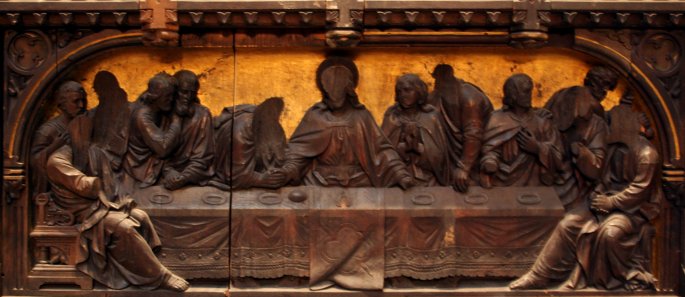
I was greeted by a man in perhaps his late 50s, with a full head of swooping grey hair. First he pointed to me to a wooden altarpiece of The Last Supper displayed on the wall. Several of the disciples’ faces, and Jesus’, were cleanly sliced off. He told me this altarpiece was saved from the church that had stood there before.
In 1871, when Berlin was made the capital, it was “just a willage,” he said.
“How do you make a willage into a capital? What do you need? People! Tens of thousands of immigrants were brought into Berlin! If you want to be a big, important city, you need immigrants! People are forgetting that these days.”
“But,” he said, “as always happens when you exploit people instead of supporting them, it was a social disaster. Wedding, which is just over there, was dangerous, violent, and crime-ridden!”
By this time, a group of Germans had wandered in and were listening to his story. I cringed at the joke before the young man even said it, so predictable was it:
“It still is!” (Wedding is a heavily immigrant-occupied neighborhood, and one of the less-gentrified in Berlin.)
The grey-haired man, in very German fashion, would not entertain this joke. He said reprovingly, “Oh no, oh no! You cannot compare now to then! The police would not even go there!”
The young man lamely muttered, “It was a joke.” The grey-haired man ignored him and went on.
“The police would not even go there! They said, ‘It’s too dangerous for us!’ But there was an initiative, called the 100 Churches initiative. This was not because the government was humanitarian, but because something needed to be done. So they built 100 churches, not to convert everyone to Christianity, because everyone was already Christian, but to provide food and aid, and a place to gather without alcohol or prostitution. And this church was one of them. But when division came and the wall was built, this area became the death strip.”
I should have known. All the best parks in Berlin used to be the death strip. The death strip was an area of raked sand between the first set of barricades and the wall itself. Cleared of all obstacles, even vegetation, it was designed to make it impossible for anyone trying to leave East Berlin to pass without being seen by one of the border guards stationed in the watchtowers built into the wall every 100 meters, who had standing orders to shoot to kill anyone they saw in the strip.
“It was terrible East German propaganda, because they called this the Peace Wall, but they dynamited a church to make it easier to kill people!”
The German tourists wandered off, and he returned his attention to me, and to the desecrated Last Supper.
“The faces are cut so cleanly that they were probably sold on the black market by East German soldiers. But I like this piece better this way, because this art is not about the event of 12 beardy guys having dinner. It’s about this,” he said, pointing to the joined hands of Jesus and a disciple.
“Now, with the faces gone, this could be anyone in the world. This could be you! This is your place!” he said, indicating again and again the joined hands of Jesus and the disciple.
And so, when the wall came down, the Church of the Reconciliation, as it is named and always was named, was rebuilt. It is a small round Kapell, dedicated to remembering and honoring the suffering caused by the division. It is free of adornment except for a cross of nails from Coventry Cathedral. Do you know this story? I didn’t know this one either:
During the war, Hitler wanted to show off the might of the German Luftwaffe (which was forbidden even to exist under the Treaty of Versailles), so he chose a random city in England to destroy utterly: Coventry, England. Over 1000 civilians were killed in one night. The ruins of the Cathedral still stand, famously, as a memorial to that carnage.
After the destruction of Coventry, a group of survivors came together to form The Community of the Cross of Nails. They opposed the war. Any war. All wars. They built crosses out of the nails that had once held up Coventry’s roof. They began to send them around the world to places that had been devastated by war. When the Allies firebombed Dresden in retaliation for the destruction of Coventry, killing 25,000 people, this community opposed it.
But, the grey-haired man said, the hardest choice was when they had to decide whether to send a cross to Berlin itself.
He said, “I couldn’t have done it. If they’d killed my daughter? I could not.”
Outside the church, they grow rye, and they make bread, and they share the bread. The previous weekend, he and his daughter took a bike trip, and they brought some of the rye brötchen with them. When they stopped to have a bite, they got to talking to three people resting nearby. As they talked and ate, he told them about the church. One of the men told them that he had been a priest, but was trapped in East Germany, where he was not allowed to minister. But, of course, in East Germany, everyone had to work, and so he was made a custodian of a cemetery—the very cemetery the grey-haired man and I were looking out over across the remnants of the Berlin Wall. Michael the Judge—for that is his name and his profession—brought out the brötchen, and the man who had lost his vocation and cared instead for the graves against the wall was fed by the rye that grows there now, in what was for so many decades a barren land made to turn civilians into easy targets.
Michael the Judge told me that they have “little jazz concerts” every Friday Feierabend (after-work-time). Last Friday, I wandered in to the freezing church to see Michael himself sitting at an electric keyboard, with a middle-aged clarinetist to his right, a middle-aged singer behind him, and an elderly man standing next to a severely disabled young man in a wheelchair. They were singing Bleibet Hier, Stay with Me, from Taizé. I sang along auf Englisch. When the piece was over, they handed me a songbook, greeted me with hugs, and asked me what I wanted to sing. The booklets were photocopies of secular and sacred songs in English and German. The table of contents was handwritten, with page numbers that would have been more helpful if any of the subsequent pages were numbered. We paged through the books and the hymnals, found songs, stumbled through them.
Eventually, a group of confirmands from Dresden, in former East Germany, came in to learn about the place and to have a short prayer service, so we sat through it and sang along. By this point my feet were freezing, as the little round clay church, which almost certainly is not heated, does nothing to keep out the early spring damp and chill. After the kids filed back out, we began a long, slow goodbye, with many returns to the keyboard and the songbook. In the middle of this long goodbye, a man and his basset hound walked in, the dog’s eyes shining like two pearly moons. With barely a hello to anyone, the man sat down at the keyboard and began to play incredible jazz piano. The dog stayed close to her man, navigating the tangle of chair legs, human legs, and piano legs with many bumps of her long nose. The man in the wheelchair took my hand and rested his head against my arm. The clarinetist waved goodbye. Michael asked me for financial advice. I have no idea why a judge and a German sought my opinion—I suppose because I was there.
The whole affair was so familiar it felt almost like being unconscious. Not just the songs I know, woven into me like a thread in a tapestry: standing around the piano with strangers, paging through music, sight reading German and a melody line at once, drawing a high harmony, then a low, stepping into a fully-formed community and being instantly a full member, no more or less than those next to me.
Like a faceless disciple, holding hands with the faceless betrayed Christ still pouring wine for his friends: I could be anyone. This is my place.


Leave a Reply to Emilia Cancel reply