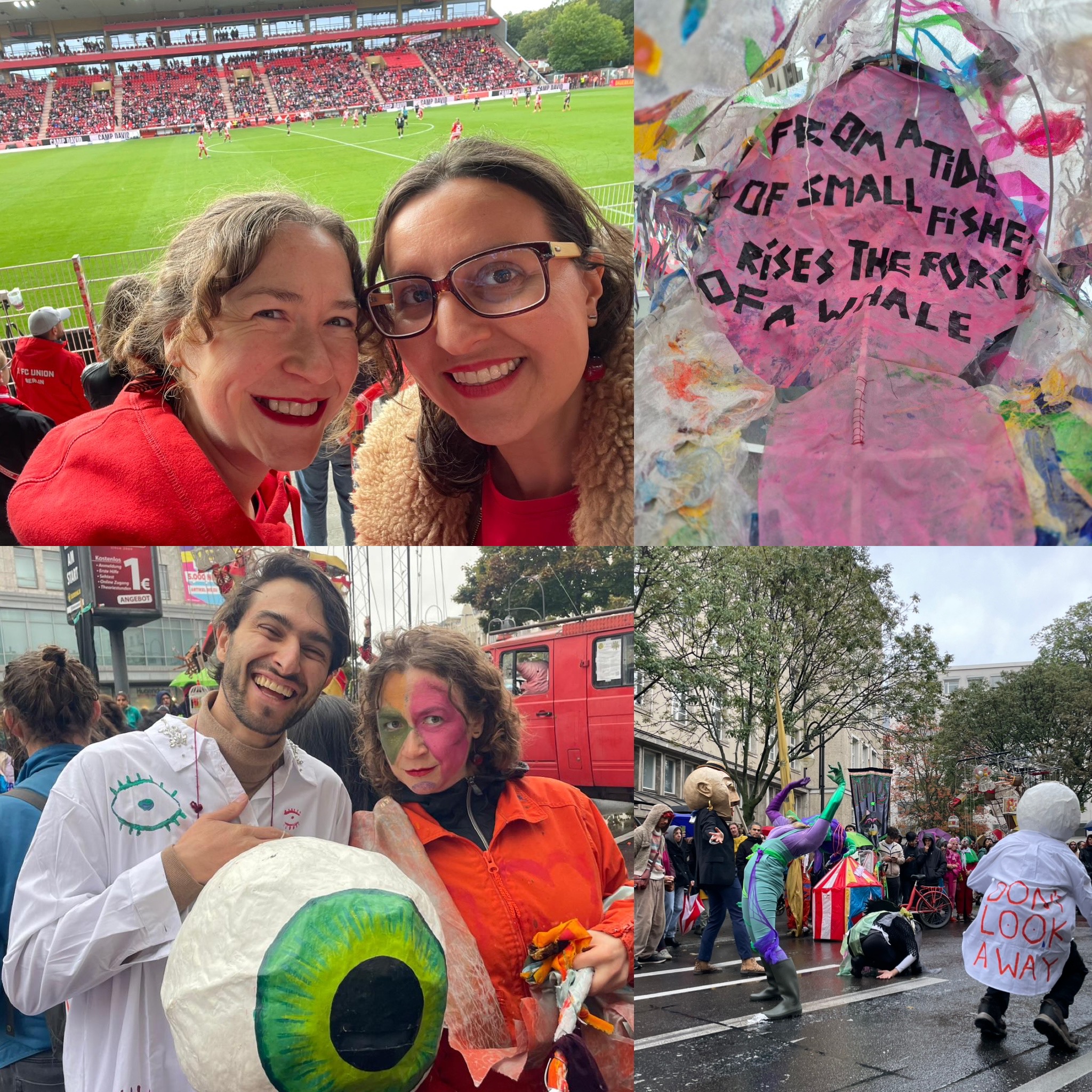
FC Union
My favorite place in Berlin is the wooded walk to the stadium half an hour before a game begins, the moment the roar of the crowd first reaches me, the trees themselves resounding. Some unnameable thrill swells up in me; I float, elated, on the loudening roar, until slowly the stadium comes into view between the trees; a corner of red, the simple gates, fellow Unioners greeting one another, my ticket scanned, the quick patdown by a female gate attendant, a friendly dismissal of “viel Spaß!” and I am here. Stadion an der Alten Försterei, literally built by the hands of devoted fans.
Which came first, my love for this team and this sport, this stadium and this fandom and this story, or the physical pull of thousands of voices chanting as one, waking up the primordial animal coiled inside my DNA?
I know the answer.
The song woke me up and beckoned me. When I joined the crowd I was warmly welcomed, the sheer masculinity of the masses modified by the fact that this is the Union Frauen team. After the electricity of the match, two little girls in the woods sold us handmade Union bracelets, €1 each, and I became a Union fan.
Unser Liebe
I am not a joiner by nature. Mostly, I never saw the point. One of my mother’s favorite stories about me goes like this: when I was in kindergarten, I was playing one day after school with some classmates. A few of my friends started some game, and as Joseph and I ran after them, one of them shouted, “Not Joseph! Joseph can’t play with us!”
Joseph was one of those kids who was always snotty. He used to tell me that his mother said he was “born with a cold.” For years I understood this to mean that if a person caught a cold in the womb and still had it at the time of their birth, they were just stuck with it their whole life long. He was also an incredibly sweet kid. He was my friend.
Anyway, when those girls shouted that—in my memory, from the top of a piece of playground equipment, down to Joseph and me on the ground—I apparently shouted back, “if Joseph can’t play with us then I won’t play with you, either!” and turned, took Joseph, and left. I don’t remember what happened after that, and I probably wouldn’t remember this event at all, except that when my mom came to pick me up, Joseph ran over to tell her what I’d done.
I told you he was a sweet kid.
I like to believe that this story reveals some pure truth about me, young as I was when it happened. One way of saying it is that peer pressure never did have much of an effect on me. But, whether then or now, it’s not just that I don’t see the point; I sense the danger.
Unser Mannschaft
Germany gets a lot of credit for its culture of remembrance and atonement for its crimes in the Holocaust, as well it should. Did you know? In its post-war scrub of anything Nazi from its culture, it changed the national anthem—but only the words. (If that strikes you as weird, you’re not alone.) I sometimes wonder if Germany’s atonement as a whole isn’t a lot like that. Sincere and significant, but perhaps not quite getting to the foundations of the matter.
I want to be clear; I’m not throwing stones. I’m from a country that has yet to apologize for the kidnapping, enslavement, torment, murder, and degradation, over 400 years, of the tens of millions of Africans and their descendants who built our country into the richest and most powerful in the world, on land that we stole, through deceit and brutality, from the people who had lived there and stewarded it for thousands of years. And we’re in a moment, right now, of ruthlessly erasing what progress we have made in telling the truth of our history from our cultural and educational institutions. I look to Germany to imagine what living honestly alongside our own history might look like, and to notice the shortcomings even in Germany’s approach. (Most obviously, right now, is Germany’s continued, though waning, support for Israel’s war of annihilation against the Palestinians, despite its most solemn vow, never again. Again, not a place where an American can throw so much as a pebble.)
Famously, Germans love rules. Less famously, but perhaps more tellingly, they’re also great joiners. This is something I admire. It’s deeply uncool, in the United States, for adults to join clubs, and look at us—crises of loneliness left and right. I’m still an outsider here; if I’ve noticed it, doubtless many others with more intimate knowledge of the culture have pointed out the pitfalls of that particular cultural tendency. But clubs are a significant part of German social life. It’s great, actually, because there’s a clear rule: to make friends, join a Verein!
Unser Stoltz
This summer, I finally read Robin Wall Kimmerer’s Braiding Sweetgrass. This book welcomed me home, back into my body, back into my place in the family of things. One idea that has stuck with me is that our gift is our responsibility, and our responsibility is our gift. This is a blessing for an artist, a permission-giving to do what I love and feel called to do and am told at every turn is a frivolity or a waste or must be measured and defended not on its own merits but by its capacity to meet someone else’s social-engineering or profit-garnering goals. Another that I keep returning to is not a new idea, but was brought home to me by this book: species loneliness. In our self-imposed isolation from and exploitation of the rest of creation, we humans are achingly lonely.
I also read Bill Buford’s Among the Thugs, his 1990 meditation on crowd violence, which emerged from his four or so years embedded with football hooligans in England. (Ultras are the organized groups of fans who bring the flags and drums and lead chants at games; hooligans are the ones who do violence.) This book is as disquieting and affecting as has been said. It’s structured as a series of essays, loosely chronological. One, in the middle of the book, coming after many essays featuring drunken nights, smashed glass, racist taunts, and wanton destruction of whole city centers, which I cannot get out of my head, is called “Waiting for a Goal.” It’s the only essay in the whole book that actually takes place at a football match. It’s a description so visceral of what it felt like to be on the terraces (the standing-room-only slabs of concrete where most football fans in Europe, Unioners included, watch matches) that I found myself holding my breath reading it, my body rocked by the crush of a crowd that formed and disbanded five thousand miles away before I was even born. There’s no sense in my trying to describe this book to you; if you have any interest at all, you should find it and read it. It is not comfortable, but it tells truths, one of which is that we are, or can easily be made to become, herd animals.
Then I read Leonie Swann’s Three Bags Full, which is a faithful, imaginative expression of what it means to literally be a herd animal (in this case, a flock of sheep solving their shepherd’s murder). It struck me at the time as a strange conceptual offspring of Braiding Sweetgrass and Among the Thugs: as the author’s gift of humility and reconciliation, to imagine the minds of a flock of sheep, and as a reminder that we, too, know what it is to be herded. In one memorable passage, one sheep says to the flock, “do not let yourselves be herded!” The others protest that it is impossible, that it is an automatic response of the legs to run when the dog says run.
Bill Buford says the opposite. He talks about the ineffable, heady sensation of a group cohering into a crowd, hovering at the precipice, all kinetic potential, urging itself to shift its weight, to shatter the social norms that keep it bound, to discharge its collective power.
I was in Ireland and Northern Ireland before the murder of Charlie Kirk and a few days before the shooting at Annunciation School in Minneapolis. In that place of infamous political violence, even before both of those acts, I was struck by the difference between political violence, which, however destructive, is committed in the name of a hoped-for future, and the violence of despair that shapes life in the United States: the lone wolf shooter whose act imagines no future at all, in fact murders the future, makes only the demand, share my pain.
Unser Verein
All last week, I was at Artistania, a transcultural, multidisciplinary artist collective, helping to prepare for Saturday’s Der Karneval für die Zukunft—the carnival for the future. All told, there were maybe 80 of us, from I don’t know how many countries—well over a dozen. All our instructions were given in English, French, Spanish, and German (by one amazing woman!). We were as young as three or four and well into our 60s. Our goal was to disrupt Neukölln with color, music, beauty, and joy; to call for a sustainable future for all life, one in which we invest in community rather than extracting profits. We were DJs, drummers, puppeteers, masketieres, clowns, dancers, satirical bureaucrats, and wavers of enormous flags. We brought out into the street a giant spider, a whale, a huge marionette with many faces, a giant eyeball (my friend Felipe!), a unicorn, dragons (one of which was me!), and other creatures real and imagined, all constructed ingeniously out of waste materials. We wore every color of the rainbow. We did not chant and we did not march; we danced and we laughed and we sang. If you’re imagining that I’ve found my people here, I think you are right.
Claire, one of the visionary founders and leaders of Artistania, wrote to our group afterwards, “More than the lack of money or sunshine, the fact that we managed to stand up for values of togetherness and respect that are currently being so brutally attacked is, in itself, a form of incredible resistance. The coming together of very different people who are willing to share their time and energy to spread beauty, to create together, to share skills and resources, to rise voices for desirable futures, all without compensation, I think is exactly what we need now more than ever. Not only to stand against a system, but to stand for another kind of society. By doing the carnival together, we are already making some little elements of our ideals become reality.”
I am so proud to be a part of such a thing. It rained all day on Saturday; my dragon kept getting waterlogged and wrapping itself around me, unable to fly, but I smiled all day, and when I left, I got hugs from several new friends. I’m excited to return, to deepen those relationships, to lend my creative sparks to others’ and see what marvelous new worlds we can build together.
Union Berlin
Union games are rituals stacked on rituals. We all wear red. Before every game, the players are announced by number, and when we hear their names we respond, with a huge, muscular shout, “Fußball Göttin!” (“Football Goddess!” And it is a powerful thing indeed to hear 10,000 people call a 20-year-old woman a goddess.) At the beginning of the game we sing the Union anthem, a manifestly cheesy and stupid song that I am growing to love. Throughout the game, we chant manifestly stupid chants.
To the tune of When the Saints Go Marching In:
Wir singen Rot!
Wir singen Weiß!
Wir singen Rot Weiß FCU!
Wir singen Rot Weiß FC Union!
Wir singen Rot Weiß FCU! (FCU!)
(“We’re singing Red!
We’re singing White!
We’re singing Red, White, FCU [Football Club Union].”
I’m sure you can figure out the rest for yourselves.)
There are rituals for a corner kick, rituals for a goal, rituals for the end of each half, and rituals for the end of every game.
We have a particular political bent and codes of conduct. This is one of the things that drew me to this team; it is a working-class left-wing team that insists on positive behavior from its fans (e.g. no insulting our players, no matter how badly they screw up). This kind of culture makes sense; in Germany, all football teams are required to be owned, by 50% plus one vote, by members. The sense of ownership is literal, the politics genuinely reflective of the members and, at least historically, the neighborhood.
A part of me will sometimes cringe away from uniformity that loud and brawny. The same strength that sweeps me up into its arms so warmly sometimes scares me. It’s like the ocean; thrilling and terrifying in its power.
Und niemals vergessen
We know that extremist groups attract lost and lonely souls, provide a sense of purpose and belonging. Many of us are extremists now. We fight not with our fellow citizens but with the ugly caricatures we have painted on our opponents’ turned backs.
Are we so lost and lonely, too?
We deny our animalness in a million different ways every day.
We remove ourselves from the food chain by industrializing, sanitizing, and shrink-wrapping the act of feeding ourselves. We process the gifts of the earth into empty, shiny dopamine bombs. We invent and reinvent convoluted diets. We forfeit our responsibility to be proper stewards of the plants and animals we depend on, preferring to deny ourselves their gifts and proselytize our asceticism.
We both under- and overvalue sex, treating what is natural as sinful and what is sinful as good business.
We treat our bodies like we treat our cars: expensive, burdensome vehicles that we nonetheless need to get through life. We maintain them more or less faithfully, ticking off tasks in the manual every few thousand miles.
We hang our lives on the cubes of calendars and clocks, rather than draping them over the circles of seasons. We rise before the sun, shielding our eyes against its rise glaring through our windshields. We swim in artificial light flooding windowless boxes while sunlight caresses our eyeless roofs. We saturate the dark with the cold glow of screens and go to bed restless and anxious.
We poison our air, water, soil, food, blood, and insist that if we stop we will lose our way of life.
We kill bugs just for being near us.
And then, flickering up through the blue light, something that makes us see red, makes our blood pump in our living bodies. The outrage pulls us like water in the desert, firelight in the dark. We feel the warmth and comfort of the herd, crushed around us, bleating agreement, their breath a lullaby.
We have trained the loneliest among us to shoot up flares of outrage when the alienation of our unnatural lives becomes unbearable. With a tweet. With a gun.
Und niemals vergessen
The homing device that leads us to the herd blinks in our very cells, but we can only build home together. Sometimes literally, with our bare hands, cinder block by cinder block in an east German forest, or by smoothing scraps of yesterday’s news over empty frames of twisted wire until a brand new future emerges, larger than life, possible only as the brainchild of coupled imaginations.
The oceanic roar of the red-clad crowd is terrifying in its forest-shaking power, overwhelming in its singular embrace, its unified voice, many tongues wrapping themselves around the convicting inanities of one language, Argentinian and British and Eastern and Western mouths singen Rot und Weiß zusammen.
The chaotic polychrome menagerie, the polyrhythm of many languages smoothed one over another on the frame of our shared project, the writhing of every dancer’s dance—that can shake a forest, too, or a city. We wear every color, we sing different songs, but the heartbeat of the drumline gives tempo to our steps and we all dance in the same direction, forward into futures imagined and not yet dreamed.
We wait for the goal and the ceasefire together.
We build stadiums and new systems together.
There is no such thing as alone. The lone wolf is only howling to come home.
Und niemals vergessen: Eisern Union!
4 responses to “Sheep in Wolf’s Clothing”
Oooo I like to spend time with your mind as you braid books and life, and even though I always think I hate sports, I hope to go to one of these games with you!
Thank you! yes, when you come we will go! It will be fun!
As a person who needs community I am finding a few really helpful me. The goofiest and most skilled are the 50501 Street Medic team. aka The Medical Squadron of The Rebellion who provide medical support to protests in the Twin Cities metro. And my very big family, my church community, and the open mic storytelling group at the American School of Storytelling. Good voices and good people who care, support and in different ways are very committed to a better future. You would have loved the rainbow unicorns at the last No Kings protest.
I’m so glad you’re finding such good communities, Peter! I was sad to miss the parties last weekend, but was so proud of everyone who showed up!