After a sleepless, waterless night on a Poland local—the train stopping every nine minutes and the carriage lit up like a midnight wander through a Walmart—and after five hours bracing my feet against the sticky floor of the waiting room in the Polish border town station to keep my seat, which was tilted like a playground slide, I finally stepped off the train into blazing sun and a wailing air raid siren. No one around me appeared panicked, and I know that Lviv, in western Ukraine, is (was) rarely hit, so I didn’t worry. Nonetheless, I was twice rebuked by official-looking men as I tried to leave the station, who instead herded me past laminated signs reading “shelter” in Ukrainian and English and into a hallway already crowded with weary-looking waiters. The missiles passed over us, hit a town in the Carpathians for the very first time in the whole war, reminded everyone how much there still is to lose.
Several hours later I was in another bomb shelter, teenagers chattering softly behind me and a stalwart panel in front of me, steady-voiced as they spoke about their stolen years in Russian prisons, or about stolen years of life with parents, spouses, siblings, neighbors who have been secreted away to Russia, where they remain to this day, denied by Russia and therefore not protected by international human rights law or oversight organizations. The sky stayed blessedly clear, and that night I slept soundly while 27 people lost their lives in Kyiv.
In May, I spent three days at the Lviv Media Forum, listening to journalists and scholars from around the world discuss topics related to the forum’s theme, Reality Under Attack: Flight, Freeze, or Fight?
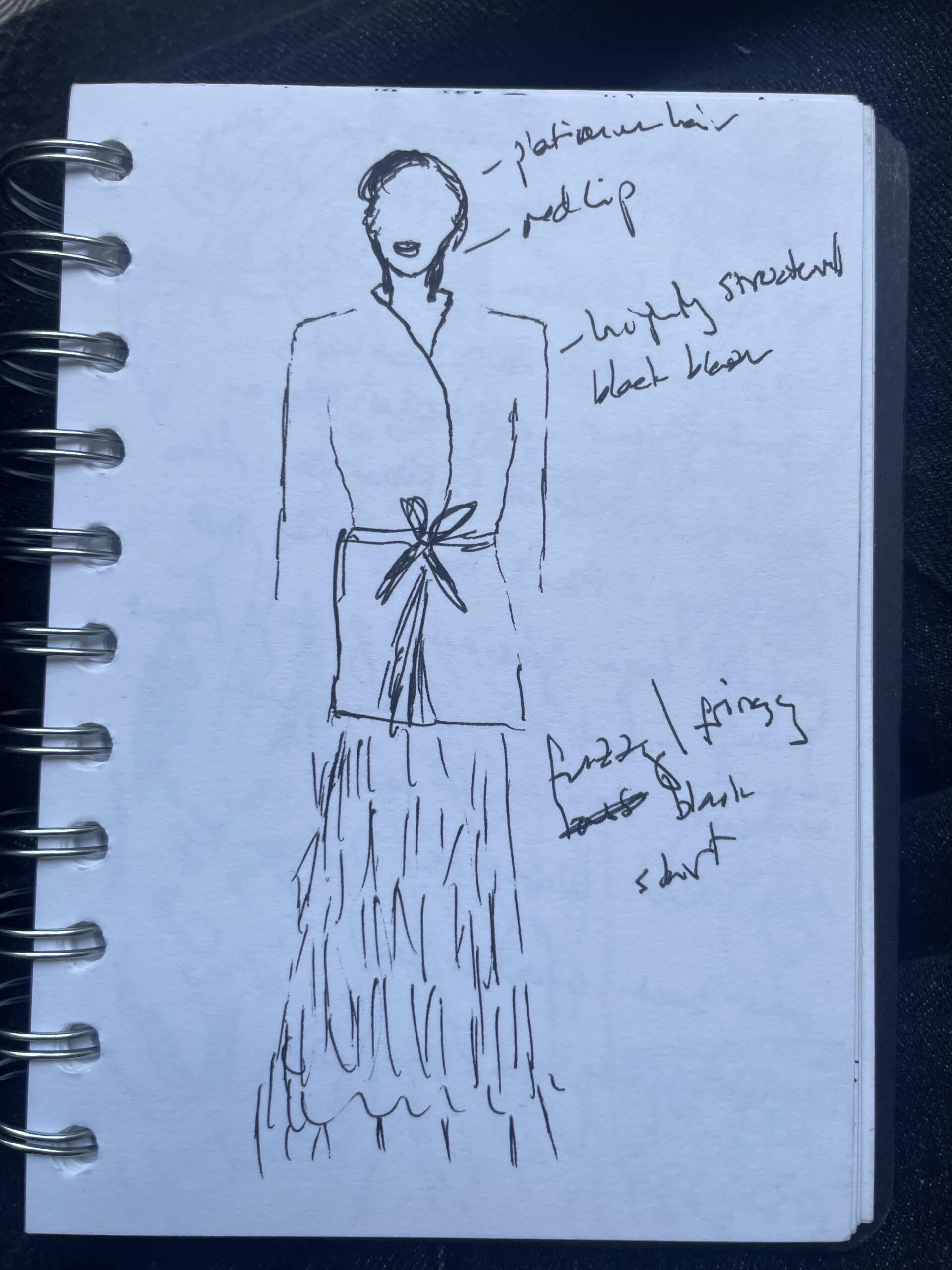
For one thing: women run Ukraine, as the men fight (of course, women fight, too). Again and again I have met very young women running significant cultural, media, and activist organizations. At lunch one day, Jared and I stood with two women whom I would have guessed were around 25 as they told us they run a museum and cultural institution that regularly hosts international exhibitions. And the women lead in impeccable clothing—clothing American women would consider too audacious, too feminine, too intricately designed, to be appropriate business-wear. Every morning, as I let generations of colonial trauma and post-Soviet nuance wash over me, I sketched the incredible clothes around me.
In Ukraine’s ongoing quest to retain, revitalize, and defend its culture, traditional Ukrainian clothing is considered perfectly acceptable to wear at any time, and much of Ukraine’s boutique fashion industry draws on traditional styles for its contemporary designs. At lunch every day, posters were put up explaining the dishes we were eating, their regional origins, their history, and their significance to Ukrainian cuisine. The first night’s afterparty was held at a decrepit old mansion that no US official would allow groups of people consuming alcohol to walk through unattended, taper candles resting on the floor beneath bare beams (the one toilet in the place had only been installed that day, and they hadn’t gotten around to installing a working sink, a light switch, or a lock on the bathroom door—war seems to change your priorities). Out on the lawn, underneath warm, twinkling lights, an electro-folk group played, the earthy, energetic fiddle sliding above electronic beats. The second night, the dance party consisted mostly of throwback Ukrainian pop hits from the 90s and 2000s, sending up a wave of joyous nostalgia every time the next song began. A young woman, a radio host living in Germany since the war began, shouted loose translations in my ear as we held hands and danced a snake through the tables and chairs, over uneven cobblestones: “He is singing about how he wants to have sex with her.” “In this one he is also trying to have sex with her.” “In this one, she is saying that she wishes she did not have sex with him, because he wants to have sex with other women.”
Lviv is home to a large military academy, meaning that everywhere I went I saw very young people in uniform. A Paris-based Iranian activist who rent my heart every time she spoke talked about the beauty of seeing a people at war who respect and honor their soldiers, rather than fearing them. She spoke beautifully—and this is the thing it is impossible not to feel in Ukraine—about the sense of solidarity among the Ukrainian people: the resolve, the commitment not just to survival but to building a truly free and democratic Ukraine.
Lviv also seems to be (to have been, in May) a place for soldiers to recover from injury. As I walked the buzzing streets of Lviv, I recalled my mom telling me just how often she encountered men with missing arms and legs when she was living in Germany in 1968. It was like that in Lviv. I walked past a pizza place, its scent of caramelizing crust enticing, and saw a huge and raucous table out front. At the end, in a separate universe from his table-mates, sat a young man with bright red hair, arm bandaged at the elbow where the rest of it used to be, staring into emptiness.
Despite rampant corruption, despite that it has not held elections since the full-scale invasion began, despite that it is under martial law, despite that it is in many ways still a conservative culture, Ukraine is the only place I know where democracy feels alive—where the stated values of the West do not feel passé, or cheesy, or suspect, or hypocritical, but desperately, urgently necessary. The phrase of the conference was “cognitive warfare.” Every speaker was clear: Russia is actively engaged in cognitive warfare not just against its own people, or against Ukraine, but against the whole West. Its goal is not to convince you of a lie, just to make you doubt the truth, make you think, for example, that elections don’t matter, that freedom of speech has gone too far, that the press is corrupt—above all, that your neighbor is your enemy. The goal of Russia’s cognitive warfare is to divide countries against themselves; to weaken internal agreement around values and facts, so that the country cannot act. And when the kinetic war is done, or paused, as it inevitably will be, the cognitive war will continue, will, in fact, ramp up.
This is not a war for Ukraine alone, yet it sometimes feels like Ukraine is the only country that knows it’s fighting it. Germany is increasing its military spending (much to the consternation of German young people, who perhaps think that missiles that fall on their neighbor are incapable of crossing the border without a visa), while public broadcasters preemptively kowtow to a far-right, pro-Russia party that has not even been elected yet. The so-called “free speech absolutists” that run our digital town squares profit off a lie as much as (more than) a truth, and from bot-farm-produced rage bait as much as (more than) a teenager’s earnest cry for real connection. These men of “traditional virtues” sit in the freshly-guilded halls of the Rage Bait King, who wears the crown that was placed on his head by Moscow in the vacuum we left when we split from one another like billiard balls, and they stuff his pockets with their ill-gotten dollars and his ears with sugar-coated fantasies of a world that bends the laws of physics and the human spirit to his whims, all laced through with whispers about how to keep the game rigged in their favor forever, how to turn the flow of money ever towards themselves. And they call it freedom, while Ukrainian teenagers die before prom, and learn to fly drones, and lose their hands before they get a chance to give them in marriage.
It’s insidious. It’s paradoxical. The genius of this cognitive warfare is that it turns our own values against us. We value freedom of thought, so we give airtime to thoughts that turn out to be lies. We value tolerance, and we end up tolerating intolerance. We value compromise, and we compromise ourselves off cliffs. But in a country at war, facts are not idle notions to be debated for a dopamine hit. Either the missile is incoming or it is not.
What Ukraine has, which I think most of the rest of the West lacks, is a (more or less) universally shared sense of identity and purpose. From the communists to the neo-liberals to the quasi-fascists, from the Orthodox Christians to the Reform Jews to the academic atheists, from the journalists to the caterers to the tour guides to the soldiers, Ukraine knows what it is fighting for, and it knows that they must do it together.
I already grieve, for Ukraine, the pain that will follow when this war ends, when they must turn again to one another, when their own considerable differences will become the central conflict. I can already see how painful that loss of solidarity and purpose will be. Some will not be able to make the turn. I am not naive: I know that these conflicts are already occurring, have never gone away, and in many cases have taken on new urgency. The people I know in Ukraine are journalists: it’s their job to crack the facade of false solidarity to expose thornier realities—to practice democracy even now, to prepare the ground for the future the country is so desperately fighting for—for the right to have those debates, to decide for itself what Ukraine means. Ukrainians know, and we in the West must remember, that when we cede that unglamorous debate, that unending tango of life together, to doubters and bots and conspiracy theorists and billionaire pirates, and when we decide to rest in easy answers that allow us to dismiss our fellow citizens as unworthy dance partners, we have already lost. And those who profit off our division have won.
2 responses to “Lviv”
Your understanding of the complexities of Ukraine’s present (over and above the fact that it has been and is at war for its existence) and, even moreso, of what its society will face once war is not its overwhelming reality, is so blessedly instructive for us here in the U.S. who are so blinded by our own bitter divisions, anger, and fears. As much as I fear for your proximity to real, physically perilous war, I am so grateful for the view you are gaining and the perspectives you are cultivating from your associations with and visits to a place so affected by the very darkest ambitions of greedy, fearful, and power-hungry men. Your writing about it is a gift to those of us here being swallowed up the by the chaos in our increasingly unrecognizable society.
Thank you, Mili. You teach me so much.
Love,
Mama
Thank you, Mama. My understanding is superficial, at best, but I also feel so profoundly grateful for the things I am learning from my budding relationships with that place and those people. Profoundly grateful. And even more so to the millions of people there fighting — with and without the world’s help — for dignity, truth, and freedom, against incredibly long odds. I can only hope that what I have learned I can share, and that what I share can be helpful in those causes.