In seventh grade, I was cast as the Reverend Mother in my middle school production of The Sound of Music. I was also in Bel Canto Singers, the premiere girls’ choir in Minneapolis.
On a grey Sunday afternoon the weekend after the cast list had been posted for The Sound of Music, while my parents were napping, the phone rang. It was the director of Bel Canto, who was also the director of children’s choruses at the Minnesota Opera (a B house, as I would later learn—a big deal nationally and an even bigger deal locally). She invited me to join the children’s chorus of the opera’s upcoming production of Carmen. I said yes instantly, stars in my eyes, and I remember she stopped me and said, “Before you say yes, let me give you the schedule so we can make sure it works for you.” This was how I learned that every yes in the theatre is contingent on conflicts.
She ran through the dates while I looked over the desk calendar in the kitchen, and I gave her my one conflict: a performance of The Sound of Music in early May would conflict with one of the opera’s staging rehearsals. She said that would be fine, reminded me to check with my parents, and asked me to call her back to confirm.
At 12, I was a Serious Singer. My voice received attention, praise, and nurture from the many adult musicians in my life. My lifelong love affair with musical storytelling was already well underway. I wanted, then, to be a professional opera singer. This would be my first professional opera. I was giddy.
Rehearsals for both shows commenced. Those of us from Bel Canto were joined by singers from the equally prestigious Minnesota Boychoir. I was fitted for my costume—a soft cotton dress, black and white checked, threadbare and ragged to suggest poverty. In staging rehearsals, I was cast as the leader of the gang of children. We were only in one scene, and it didn’t take long to learn our blocking. The dusty, stale smell of the big, brick rehearsal room thrilled me. It whispered my name when I walked in.
One day in late April, my dad took me to the opera center and, as I had been taught to do, I went to my mailbox first thing (I had a mailbox!). There was a revised rehearsal schedule in it, which now showed rehearsals conflicting with all three of my Sound of Music performances. I went to my director right away and told her about the new conflicts. Her reaction was unexpected to me—she seemed surprised that I was even telling her. She seemed to presume that I would simply skip my middle school performances. When I told her that I could not, that I had committed to that production first, that people were counting on me, and that I had told her about those performances in our initial phone conversation, she got angry. Reluctantly, she said she would speak with her colleagues to see if I could be excused from those rehearsals.
Now, as a veteran of professional theatre, I have some sympathy for her position. A child in the chorus, present for one scene, is not an important member of the cast (yes, there are small parts), and yet the important members do depend on everyone’s presence to do their work. Every piece of theatre with a cast of more than one, even grand opera, is an ensemble. It must have been embarrassing for her to have to ask her colleagues to attend to the scheduling conflicts of a seventh grader when the busy professionals, with their international careers, were making it work. Perhaps—and this is the first time this is occurring to me—she was frustrated with them for changing the schedule and putting her in a bad situation.
As my dad and I stood in the green room, I remember the prickly uncertainty of that few minutes. The twisting in my chest, the fear of losing something I wanted so badly and loved so much. I remember tears standing in my eyes, ready to fall or to fade.
She came back. The answer was no. I could not miss those rehearsals. When I told her that I could not quit my middle school show—which, after all, was in dress rehearsals at that moment (I had negotiated with them to be late so I could attend this Carmen rehearsal)—I remember she hissed at me, truly hissed, and I will never forget it: “This is the Minnesota Opera!”
I turned and walked out the door, the tears spilling hot down my face.
My dad stood behind me through all of this. He let me speak. He followed my lead. When she turned to him in appeal, reasonable adult to reasonable adult, he backed me up, said something like, “She did commit to them first.”
As we turned to leave, through my own tears I saw tears in my dad’s eyes—the first time I ever saw that. I was confused, not just because I’d never seen my dad cry before, but because I didn’t understand why this moment, of all moments, is when they would appear. Now, of course, I know what it was.
It was pride.
I don’t know where this iron sense of commitment came from, but I do know that for me, it’s black and white and, somehow, personal. A matter of respect. Foundational. If you say you will do something, you do it. If others are counting on you to be there, you be there. If people I love are counting on you to be there, you be there. If people I can’t stand are counting on you to be there, you be there. If I am counting on you to be there, you be there. I could tell other stories about my inflexibility in this regard. But that Carmen story is the first. It’s a foundational story in my life. One of those moments that I learned something fundamental about who I am, for better or for worse.
I fall short of this ideal all the time when the expectations are murkier. I’m not very skilled at maintaining long-distance relationships, at least with the degree of intimacy I would like. I’m an inconsistent correspondent, as most of you well know. It’s something I’d like to change. It’s a change that feels urgent, now that I am so far from so many people I love.
And yet—
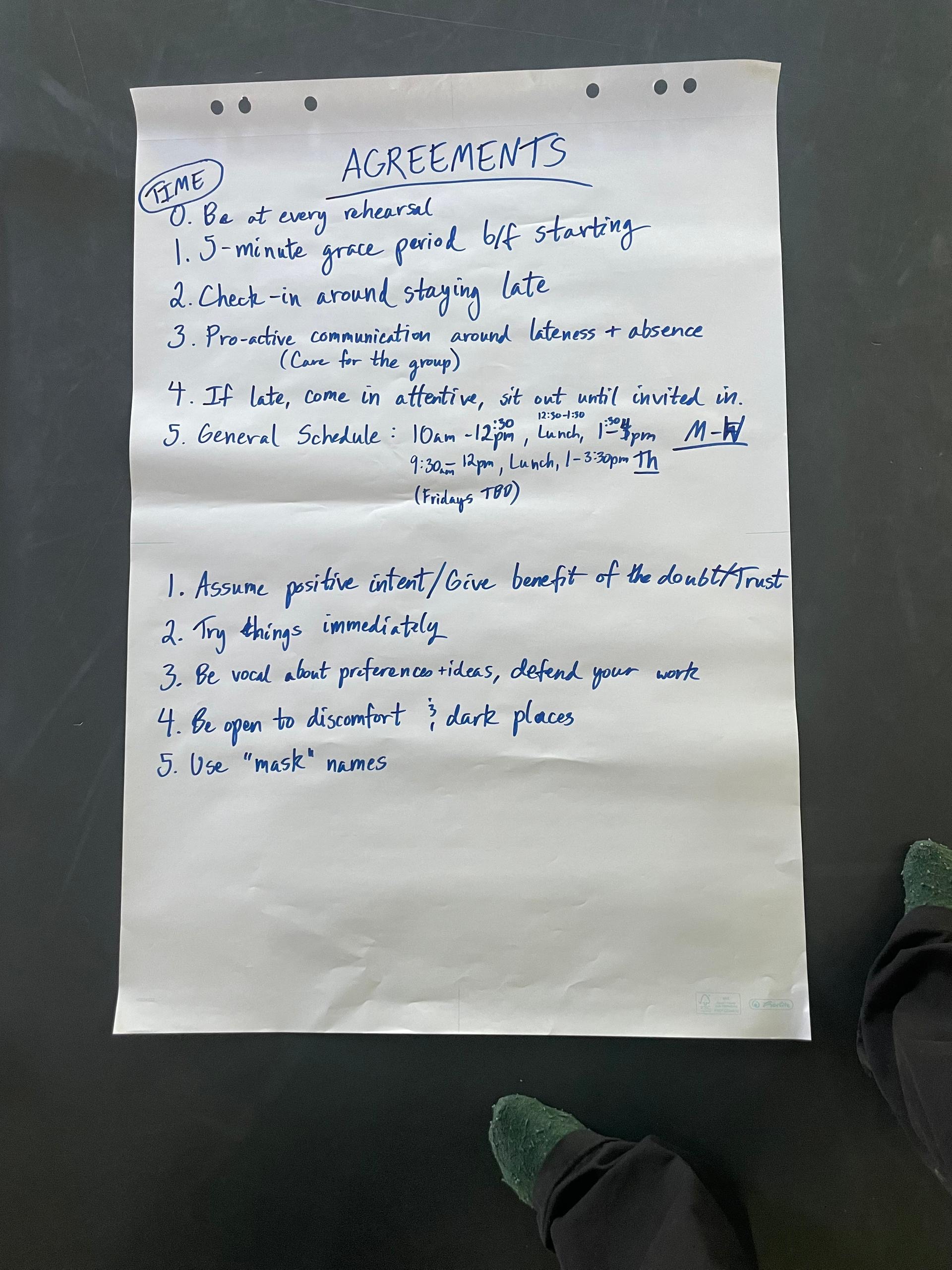
My school year is done. We co-created and performed a piece, all 11 of us, that I am proud of. And I am proud that we did it. It was so hard. It was not as fun as I would have liked. We had—I pushed for—a few conversations about expectations, shared agreements, how we work together, what we owe each other—that left me aching and empty for days afterwards.
This year has not surpassed or even met my wildest dreams.
It was the right choice. I’m grateful that I’m here. I’m getting the education and experiences that I need. But it’s been a marathon.
And my biggest heartache has been around this question of commitment. The fly in the ointment has been that this group of us never did agree on the simple, constitutional task of showing up. Even when it’s hard. Even when we don’t want to. Even when we’re not feeling shiny.
I had assumed—truly, I had assumed—that anyone and everyone picking up their whole lives to move to a new country, a new continent, to put themselves through the pain of German bureaucracy and the surrender of thousands of Euros to study collaborative theatre would share with me the basic understanding that in order to do the work we have all sacrificed so much to do we must be present, physically and energetically, in the room, on our feet, together. To me, this is quite obviously the bare minimum.
My assumption was wrong, and I have not stopped feeling crazy since I realized it. I have turned myself inside out trying to ask for what I need, trying to explain what, to me, feels not only like an unbreakable law of theatre but an incontrovertible law of physics. Trying to explain how hard it is for me to remain vulnerable and open-hearted, as our work requires, when I do not know if I can count on my collaborators. I have tied myself in knots trying to empathize as I have been told again and again that my expectations and needs are simply unreasonable. I have grown cold and reserved. I have regressed to a version of myself I do not like. It has been punishing.
My supportive and compassionate friends remind me that I was not given the space or grace to be my best self. Many people listening to this story have asked, “Is this, by any chance, a generational divide?” Which it is. Which feels like a larger problem I am not prepared to deal with at this moment.
I was friendly with a girl in college who once told me that she’d broken up with her boyfriend of several months. She said he drank too much, and that it made him unreliable. She said that she asked him, “What if I need you and I can’t reach you?”
At the time, I found it shocking. A woman, saying she might need something from a man—how retrograde. A woman, actually telling a man she might need something from him—how humiliating! A woman, breaking up with a man she cared for because he didn’t give her what she needed—how . . . strong. How freeing. I still think about it all the time. It doesn’t surprise me that, according to social media, she’s happily married now, with a beautiful family.
At 40, I’m still learning what she knew how to do at 20. I’m still learning how to walk away with love from what doesn’t serve or support or make space for me. One of the challenges of this year has been feeling like I’m marinating in that tension: I would not choose to work with people who are as unreliable as some of my classmates have been—people I like, care for, and whose talent I admire—and yet, in this situation, I cannot walk away, not without sacrificing my own education and becoming exactly what I am critiquing. I spent this year on Bambi legs, too shaky and frail to take a step.
I have not yet learned how to stay in graceful relationship with people who disappoint me. I guess I need to learn, but it’s not what I came here for.
At least, I didn’t think it was.
6 responses to “Bambi Legs”
I get it. Gift or challenge or curse or all?
I have been told often, for decades, that I am too rigid about keeping my word. I do meditate on the question. And sometimes deal by not committing. It is a part of who I am. Thank you for this post.
What does that even mean, to be too rigid about keeping one’s word?!
Thanks for the solidarity, friend!
It was also sadness that you had to make that choice.
I think about that evening often. The universe stepped in to help me be a better father than I imagined I could be. We weren’t allowed, with good reason, as parents to observe or be in the rehearsal room. I would usually drop you off. The lounge was small and boring so I would go out and do something else until rehearsal was finished. That day I didn’t. I stayed and the universe had me there for you at that time. I didn’t plan it.
Often I think about that. What if I hadn’t been there and you had to sit in that lounge, alone, for that entire rehearsal until I came back at the usual time? I am so fortunate that I was able to be there for you and that you were able to become the person you are. Love you
You were just exactly what I needed right then, Daddy. You were just perfect. And I am so grateful. And I am so, so, so glad that you were there. You’re right, it would have been agony without you. I love you. Thank you.
I know this feeling, and I want to say something like “ah, this is art, we show up no matter the outcome, we commit over and over to vulnerability even when it is painful, the real strength is staying open and not closing down” blah blah blah – but I also think it’s reasonable to ask for commitment and buy-in from our collaborators, and I’m not sure how anything would be created without that trust. And I see the value in negotiating these boundaries for ourselves, I see the benefit or wrestling with these questions. Strength, friend!
If real strength is staying open and vulnerable in the face of what feels to me a lot like disrespect for my time and presence and our shared work, then I am weak af. It’s ironic to me that people ardently resisting the exploitative models of the past ended up creating a new exploitative model, in which those of us who showed up consistently and put in the work were expected to do things like keep giving our best in the face of not getting that in return, temper our expectations for communication and reciprocity, share our work generously and patiently with those who were absent, and “just deal with the anxiety of not knowing what’s going on with me” (aka, “suck it up”). Exploitation came in the form of the crazy-making assertion – actually, literally asserted – that somehow absence (whether energetic or physical) and presence (both energetic and physical) are contributions of equal worth.