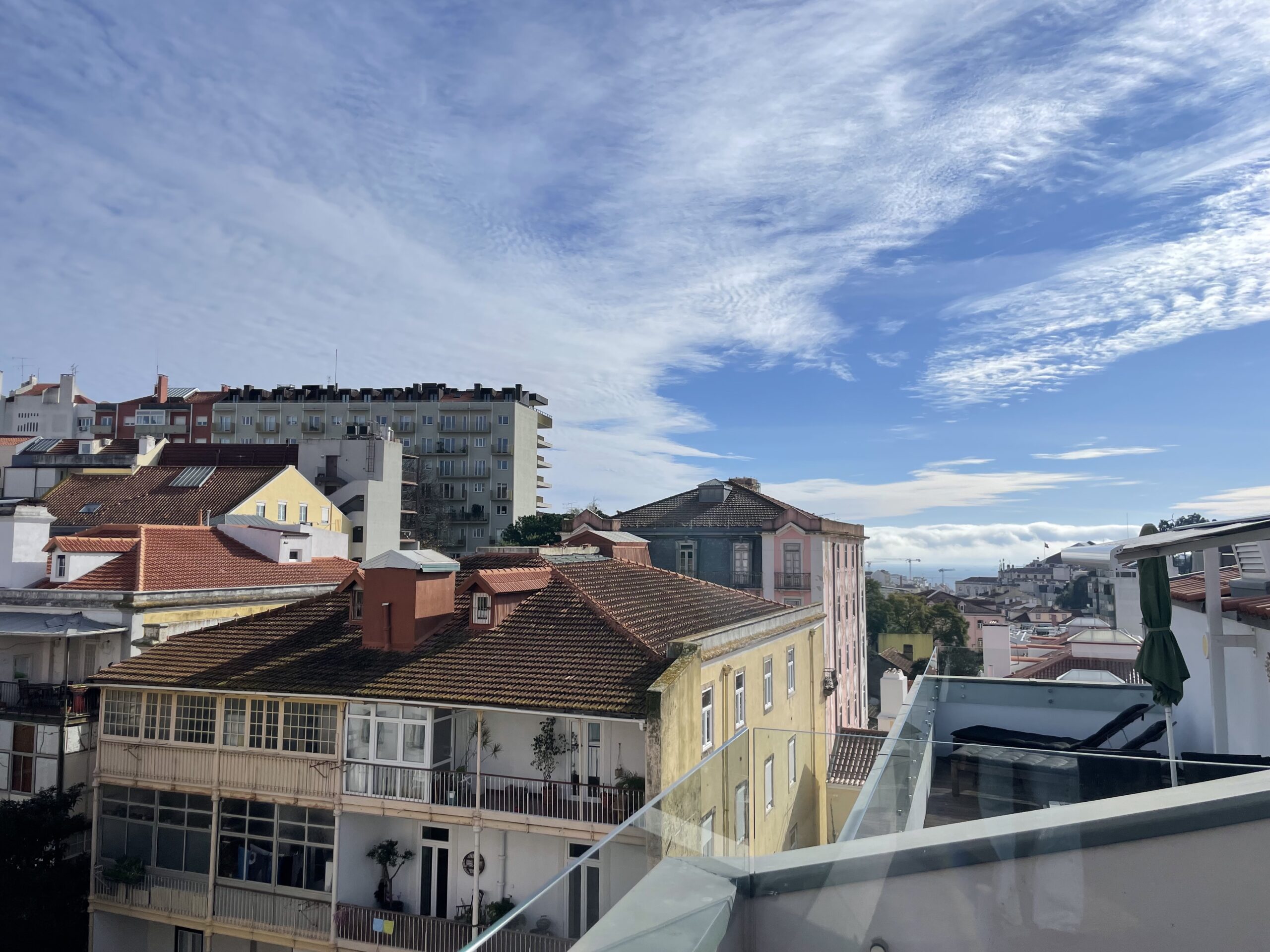
This morning’s heavy fog is bright. I sit in the cloud, up here on the sixth floor, and watch the air around me shift from white to gold to rosy pink. Just overhead, soft grey shadows race down the hill to the Tagus River, where every minute a sonorous foghorn sings out. It sounds gently, as though trying to preserve the mystery of this morning, even as it dutifully reminds us that a hard reality persists.
A pandemonium of parakeets squawk below me, the free descendants of some long-ago fugitive from domesticity. They flash across the sky, lush green leaves on the wing.
And now, tinny church bells clang, somewhere in the mist.
A perfect paper cutout of a seagull soars dark across the bright white sky.
The birds resume their chorus—redstarts and great tits, linnets and blackbirds, swallows and black caps, all singing in the new day in their particular way.
All in all, an excellent way to bid adieu to 2025. Or should I say adeus, auf wiedersehen, прощання (proshchannya)?
2025 has been a year out of time and out of place for me.
I “lived” in six different flats. I traveled a lot. By my count, I slept in 30 different beds in nine different countries—ten, if one is a Welsh separatist. (The count doesn’t change if one considers Northern/the north of Ireland to be a part of Ireland, because I also slept in Dublin and in Liverpool, but, I have learned, there are many people who would want me to take this opportunity to make a point about Irish reunification.)
And I had the luxury of those kinds of travels. I had the luxury of long days in the studio, long breaks from school, long meanders with my own wondering, and no other particular demands on my time. It’s a coarse but accurate way to speak about this season of my life: I have bought myself time. I have bought myself two years to focus on what it means for me to be an artist now.
But 2026, this fresh-faced new year that arrives tonight, will come with its hand out.
Join me in keeping an eye out for the gleam of an answer hidden in its other fist.
I was invited to a party a couple of weeks ago by two older friends to celebrate the completion of their two-year journey with arthaus. They were in a different program than I am, one which I considered, but ultimately decided against for reasons both practical and programmatic. Their journey was more personal and introspective, less focused on collaboration, and, reading between the lines, more geared towards those in or past mid-life.
In thanking them for the party, I stumbled into a fairly succinct explanation of where I am right now:
As I stare down the second half of my second year at arthaus, a wide horizon of post-MFA life in Berlin starts to come into view, blurry and big and, so far, empty. I want to thank you both for the examples your party gave me — of what community here can be, and of what being a faithful artist as one ages can look like. I am 41 and am still shocked every time realize that I will never be young again, and that my life cannot and will not ever again be propelled forward by the hurricane-force winds of ambition that drove the first half of my life.
When my company died during the pandemic, I suffered massive ego death, and now I don’t know what is fueling my art, because that raw, starry-eyed, take-no-prisoners ambition is gone. I tried not being an artist for three years and my life was a daily heartbreak, despite everything being so, so good on paper (including being financially comfortable for the first time in my life!) so clearly I needed and need to be making. But it’s got to come from a different place now, and whatever that place is, it’s still quite underdeveloped. And so I must continue to find gentler, deeper, more honest ways of being and making. You have given me some glimpse of what that might look like, and I am very grateful.
To briefly answer the question I know many of you have, this year is better than last. Some of my classmates still have a more lackadaisical attitude towards attendance than seems appropriate or beneficial to me, and I am gratified that my facilitators are more openly frustrated about it than last year’s facilitators were. I have also reached a peace with it. I work with those classmates who are present and reliable, and I don’t work with those who aren’t.
Our instructors seem to be more aligned with one another in terms of what they hope we get out of our classes. There is more emphasis on the role of the artist in the world, on being a maker and a writer, on the fact that our work is powerful and mystical.
I still don’t always like how I show up in our devising time. I get frustrated, and it shows, and I hate that. I have started openly saying that I don’t like working only on the inside of a devising process; as a director, I need to be outside in order to have any sense of what we’re doing, or to get any joy from the work. It is a relief to claim my own needs and ways of working, and to advocate for my own enjoyment.
This program is challenging me in important ways that will have a lasting impact on my life and work. Namely, I am being asked to find and defend my own artistic voice — in my body — with a rigor I have not faced before. I am being asked to notice and faithfully follow what resonates with me, regardless of its utility to anyone else. It is hard, vulnerable work, and most of the time I don’t feel very good at it.
The hardest part about being here, still, is that I still don’t have the kinds of daily intimate relationships that can support and buoy me outside of class, so that I can keep showing up to do this vulnerable work with grace. I don’t feel very well seen or known or loved yet, on this side of the ocean. I have friends, and I’m always meeting new ones, but, as my aunt Joy said to me the other day, growing good friends takes time.
Yesterday evening I found myself in a beautiful bookstore here in Lisbon, all wood-paneled, and the leather armchairs giving off their scent of old refinement. In the basement I found a book of Berlin photographs and looked through every page. It is uncool to admit it, but I find that I am falling in love with Berlin. Not with Berlin spread six storeys thick across the flattest part of Germany, but with Berlin whose roots dig deep into the messy mystery of human history, and whose branches spread wide to touch every corner of the globe; Berlin whose tangled streets hold the sublime and the mundane, whose heights reach the godly and whose depths revel in the profane; Berlin of agony and privilege, Berlin of refuge and ambition, Berlin of sweat and propriety; Berlin who suffers, Berlin who sins, Berlin who ever changes, and Berlin who endures.
I really sound like a Berliner when I say, I like that it’s not the most beautiful city in Europe. I like that it’s an inelegant mix of generic corporate slick and gratuitously uncouth squats, their dilapidation a protesting shout. I like hating west Berlin, the wide streets smooth as scar tissue where American dollars yanked out the tram lines, turning the free west into a bland, wedding cake imitation of any mid-American city, complete with unrepentant Nazis folded right back into daily life and leadership. I love that, at least when I am not in the tunnel vision of classes (9:30am-6pm daily, with evenings set aside for our devising time, and frequent weekend workshops—this is why you have not heard much from me this fall), I weekly meet people who complicate what I think I understand about the world.
In a week I will go to Warsaw for a night; I will then go on to Cairo for another week. When I get back to Berlin on 16 January, I will have a couple of breathing days before classes start up again on the 19th. From there, it is a freight train straight through to April, when I will suddenly be cut loose to research and present a practical expression of my profoundest most resonant research questions, which will happen maybe in April or maybe in June or maybe both or maybe late August to early September or maybe all three. I will then have until the end of October to write and submit my documentation of this research period. My current visa allows me to stay in Berlin until early December, so I have until then to figure out how to stay and what’s next and the rest of my life, although I must start making money before then, for reasons of survival and eventual visa-getting.
The fog has cleared, and the sun is shining brightly down on Europe’s sunniest capital. The blue, blue sky has a summerweight white duvet spread fetchingly across it. The grass is green, the birds are quiet, the boats are out on the wide river once more, and the many cranes of a rapidly growing Lisbon are towering over this old city, at rest in honor of the holiday.
As you each discern what resonates for you now, as you each seek the light that will shine on your next steps, as you look around the life you have with, I hope, gratitude and trust, I thank you for being in relationship with me. I hope this next year gives you what you need, and some of what you want, and is gentle with you.
In 2026, may the world rediscover its imagination. May we collectively begin again to imagine a future where all the world’s human children can live in peace, with justice, with self-determination, with enough and not too much, in right relationship with one another and with the rest of creation, our family. And may those of us who dream these dreams have the will to share them and the faith to trust that they matter, that our imagination is needed, desperately needed, even when it is not wanted. Because if we can imagine it, we can build it. I really believe that.
Happy New Year! Frohes Neues Jahr!
2 responses to “The Foghorn and the Parakeet”
Dear Mili,
First of all, my breath is more and more taken away by your writing. You are a poet even when you are not writing poetry. Your description of the morning in Lisbon is so personal, so much a product of the specific spot and moment from which you are observing, and yet, now it is Lisbon to me as I would never imagine it from a travelogue. When I was in elementary school, somehow Daddy through his work came into possession of a whole stack of 45 rpm records, never best-sellers certainly, but still, to me interesting music that I played on my little portable record player all the time. One of the sides was an instrumental piece called “Lisbon Antigua,” a sprightly, slightly clangy ensemble song that had enjoyed some moderate popularity on the radio of the time. I played it over and over and formed a quaint, sweet impression of Lisbon (a city I have never had the pleasure of visiting) solely from that music. Now your lovely words of today join that remembered tune to augment my imagination of Lisbon.
Imagination is so central, isn’t it? Your description of your life in Berlin and where you are in the process of making hugely important personal decisions is so much in synch with the state of the world right now. We are so in need of people recognizing that their important personal decisions and how they imagine themselves going forward in the coming years will determine what happens to our world, its people, its other inhabitants, and the future. I’m so glad you have had and will have for at least a while a place outside the United States from which to observe your native country. I found that so helpful when I lived in Germany during the height of the Vietnam years. It’s hard to see clearly in the midst of a maelstrom; it’s better if you can regard it from afar.
I know what an important place and metaphor Berlin is for you. I so wish I knew the city better. It stands at and AS a crossroads still, doesn’t it? As it seemingly nearly always has. Bringing together so many people of myriad ethnicities and nationalities, histories, ideas, lifestyles, cultures, and, without a doubt, human dreams and hopes, perhaps most particularly in artistic pursuit and offering as a means of human development. I can think you live there hoping in some way to transcend taken-for-granted nationalism and commercialism as THE way to exist in the political world.
In early 1969, Berlin was, of course, as physically and politically divided as a single city on planet Earth could be. I came there one long weekend on a train from Mainz to a Fulbright conference to be held in West Berlin. The train stopped at the East German border, where it was boarded by East German police who meticulously scrutinized the passengers and perused our passports, other travel documents, and luggage. Outside the train, other police held the leashes of several dogs who sniffed the train with interest; still other men maneuvered giant mirrors on wheels to give them full view of the underside of the train. After the inspection was accomplished, the train continued its journey through East Germany until we reached West Berlin where we disembarked near Checkpoint Charlie.
I went to Germany in 1968 as a Fulbright student grantee and got to know some of my fellow Fulbrights in Germany on an 8-day ocean voyage from New York to Bremerhaven that the Fulbright Commission had arranged in September of that year to transport us while we were in meetings to orient us to Germany and the Fulbright program. Some of my fellow Fulbrights and I stayed in touch by mail and by visiting, and my circle of Fulbright acquaintances grew during the year. Some of my friends from other parts of Germany and I had arranged to meet at an East Berlin cabaret the night before the Berlin conference began, and so my first destination upon arriving in West Berlin was Checkpoint Charlie and East Berlin.
I found myself uneasy navigating the crossing and finding the cabaret in East Berlin, since the Fulbright Commission had made it very clear that we should be very mindful of the fact that, unlike with other Eastern Bloc countries, the U.S. had NO official diplomatic relations with East Germany. In other words, if we got ourselves into trouble in East Germany, no one from the U.S. was likely to be able to come to our rescue. We were on our own. These warnings were aimed primarily at those individuals who might seek or carry illegal drugs or substances or try to smuggle in black-market goods or exchange currency in prohibited ways (which some people still actually did), but there were also simply warnings that we securely safeguard our identity documents while in East Germany.
I made it through Checkpoint Charlie without any problem and soon found myself on the streets of East Berlin, probably not all that far from some of the places you have lived since you’ve been in the city. But at that time, of course, the wall and its surrounding territory were the central feature of the city, and once I was on the eastern side of it, I became very conscious of where I was and the fact that I, at least until I found my friends at the cabaret, was alone.
I knew where I was going and was walking quickly along a street toward the cabaret when a man approached me. He looked disheveled and seemed drunk. I tried to ignore him but he kept speaking to me in German. He wanted to know where I was from, said he could tell I was not native German. I kept walking, and he kept guessing what nationality I was: Swedish? Danish? English? I denied them all in a manner that should have let him know I wasn’t interested in talking to him. He was extremely persistent. Finally, exasperated and feeling somewhat proud to be able to say it, I came out with “Ich bin amerikanisch!” He immediately stopped and acted very, very surprised. “Nein, nein. Sie sind keine Amerikanerin!” And the argument was on. I spoke German, and no Americans spoke German, I didn’t look American, my clothes and shoes weren’t American, etc. Finally, I lost my patience and my temper and pulled my passport from my purse. That was apparently what he had been waiting for; he immediately grabbed it out of my hand. My heart sank to my feet, and I began to plead with him to give it back. But he was suddenly no longer the least bit drunk, and he apparently had no intention of making off right away with my passport. He simply stood on the street and slowly flipped through every page of the document, looking for a long time at my picture and at every stamp I had acquired the entire time I had been Europe. I was nearly in tears when he slowly closed the booklet and very calmly handed it back to me. He then walked off down the street as if nothing had ever happened.
After describing the encounter to my friends at the cabaret, I listened to their opinions about what the man’s intention might have been. The explanation that still makes the most sense to me is that he was engaged in helping people escape from East Germany, and he must have been looking for passports and documents that might be capable of being altered to match some of the people who were seeking his help to escape. The immediate penalty for trying to escape the Deutsche Demokratische Republik was death, as was proven fairly frequently when people were shot and killed by East German border guards while trying to escape. People did make it out occasionally, but usually with simulated documents rather than the daring runs for freedom that almost always resulted in injury and capture or death.
I have since thought about the fact that he didn’t simply take my passport and run, which he could easily have done. I’m pretty sure that, although it would have been a terrifying experience for me, I would eventually have found a way back to West Berlin. He saved me that trauma by doing his inspection on the street and readily giving me my passport back. I also now realize that he was putting himself, very probably in order to give someone else a chance at freedom. I have wondered whether he himself ever found a way out. Or perhaps he is still living, as a very old man, in Berlin, maybe somewhere near you.
I think often in these days about how dreams and hopes change over time, adjust to new realities, reflect the intransigencies of whatever hampers, discourages, and tries to kill the best that human imaginations have to offer in any given era. There seem always to be those whose idea of success or fulfillment are grounded in ideas and commitments as shallow as tacky gold tchotchkes on a mantelpiece and gawdy empire ships so big and “beautiful” that they are of no practical use whatsoever. And then I think of you and others in cities like Berlin, and Kyiv, and Chicago, and Los Angeles, and New Orleans, and Minneapolis, and Spartanburg, who are there seeking deep roots and wellsprings and light that their histories, cultures, intellects, and hearts imagine and demand in order to nurture something worthwhile for everyone and everything here on our fragile planet: community, understanding, and enough of what is required for life and growth and peace and a little joy and sufficient love and, always, a measure of awe.
Thank you, Mili. May your blessing today be just as you offer it, and may it include you and all of those who seek something better and truer and more lasting, and all of us.
With enormous love,
Mama
Wow – thank you, Mama! I’ve never heard the whole passport story before – thanks for sharing it! I could imagine exactly where it might have happened.